


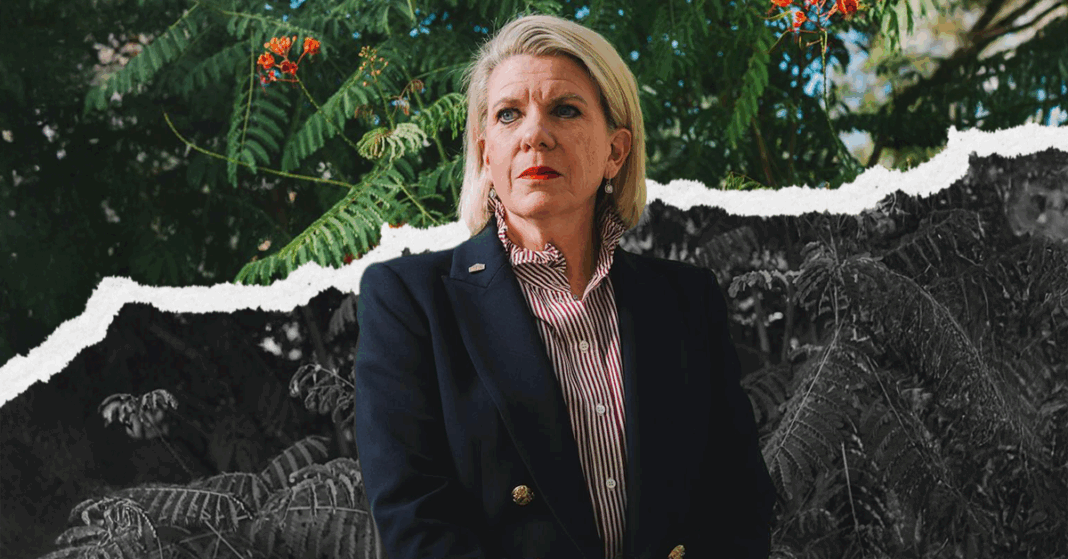
In a recent interview with the San Antonio Report, former Alamo Trust CEO Kate Rogers offered her first extended public explanation of why she is challenging the state officials who pushed her out. She is sure that her case reaches far beyond her own job.
In October, Rogers was asked to resign after state leaders pointed to passages in her years-old doctoral dissertation as evidence that her personal politics were “incompatible” with the state’s vision for the Alamo project.
The redevelopment continues without her, but Rogers has filed suit against Lt. Gov. Dan Patrick, Land Commissioner Dawn Buckingham and members of the Alamo Trust board, seeking reinstatement and accusing them of violating protections for academic speech.
Rogers told the San Antonio Report that the circumstances surrounding her departure made it necessary to respond publicly.
“What’s unique about this situation is that the reason that I was asked to resign was because of something I wrote in my dissertation, which is protected speech under the First Amendment,” she said.
“I felt compelled to fight that, because that’s a dangerous precedent.”
Rogers said that during her tenure, her focus was managing a historically charged project with intense political scrutiny on all sides. The Alamo, she noted, has long-drawn strong reactions about what parts of history to emphasize. “There’s strong opinions on both sides,” she said, adding that her goal had been “to try to balance those points of view.”
She described her interactions with Patrick as cordial and said his support was instrumental to moving the half-billion-dollar plan forward. “This project would not be advancing forward were it not for him,” she said, while acknowledging how abruptly that relationship shifted when her writings became a political flashpoint.
The tension escalated after the firing of the Trust’s communications director over an Indigenous Peoples’ Day post, followed by Rogers and later script writer Steve Harrigan.
“It’s interesting to me that cancel culture was a term that was sort of created on the left, and now over on the right, it feels like, ‘Well, you can’t say that word,’” Rogers said.
How Her Dissertation Became a Flashpoint
Rogers emphasized that the dissertation itself was not about the Alamo, but about how major U.S. historic sites support K-12 social studies instruction.
The section that drew criticism, she explained, was a routine requirement in qualitative research. It was meant to describe “the political complexity that surrounds the Alamo,” noting the contrast between conservative state leadership and more progressive city leadership. She said Patrick appeared to interpret it differently: “I think [Patrick thought] it sounded as though I was being critical of the Texas Legislature.”
Rogers warned that the episode sets a troubling model: “It puts a lot of people at risk if we live in a place where you write something at one point in your life for a very specific purpose … and then later that it’s used as a weapon against you, for someone with a specific agenda.”
Looking Forward
Rogers said she is still considering what comes next, but wants her work to continue having impact.
“Whatever I do next, it needs to be something that has meaning,” Rogers declared.
On whether she would consider public office, she added: “I never say never,” noting that political life has grown so toxic that “a lot of good people don’t want to run,” even though their participation may be needed for change.